
Advancing Healthcare IT Solutions
Published: May 18, 2023
By: Gene Everette, David Nicholson

Hyperconverged Healthcare IT Solutions for Clinics & Physicians’ Offices
In today’s world, healthcare data is growing at an unprecedented rate. The increasing amount of data has led to a need for more efficient and reliable infrastructure to manage it all. That’s where high-availability hyperconverged infrastructure comes into play. Hyperconverged infrastructure (HCI) simplifies IT operations by combining storage, compute, and networking resources into a single system. This technology has been rapidly gaining popularity in the healthcare industry due to its unique ability to optimize performance while reducing costs. Here we will explore how health clinics and physician offices can benefit from using HCI as their healthcare IT solutions and why they should consider making the switch.
Ultimately, the main goal of any clinic or physician’s office is to provide quality care to its patients. Hyperconverged IT solutions play a crucial role in achieving this goal by improving operational efficiencies within healthcare facilities. By streamlining processes and reducing the time spent on administrative tasks, healthcare professionals can focus more on patient care. Additionally, with faster access to patient records and better data management, physicians can make more informed treatment decisions resulting in improved patient outcomes.
Ultimately, the main goal of any clinic or physician’s office is to provide quality care to its patients. Hyperconverged IT solutions play a crucial role in achieving this goal by improving operational efficiencies within healthcare facilities. By streamlining processes and reducing the time spent on administrative tasks, healthcare professionals can focus more on patient care. Additionally, with faster access to patient records and better data management, physicians can make more informed treatment decisions resulting in improved patient outcomes.
What is Hyperconverged Infrastructure?
Hyperconverged infrastructure (HCI) is a relatively new healthcare IT solution, that has been gaining popularity. It essentially combines storage, networking, and compute functions into one system. This means that instead of having separate silos for each function, all aspects of IT are integrated into a single platform.
In hyperconverged storage, virtualization plays an important role, because it allows organizations to run multiple applications on the same hardware. This leads to significant cost savings, as well as increased efficiency since there is less hardware to manage.
Another key feature of HCI healthcare IT solutions is its scalability. As healthcare data continues to grow exponentially year after year, it is essential for clinics and physician offices to obtain a solution that can easily expand, without disrupting operations. HCI makes this possible by allowing organizations to add capacity as needed without replacing entire systems.
Security is also an important consideration when it comes to healthcare data. With HCI solutions, sensitive patient information can be securely stored and protected from unauthorized access or breaches.
There are many benefits of hyperconverged infrastructure for healthcare organizations looking for a more efficient way of managing their medical IT solutions while ensuring the security and confidentiality of patient data.
How Has Healthcare Data Grown?
The healthcare industry is one of the most data-intensive sectors in the world. The growth of healthcare data has been exponential and will continue to increase. “Statista projected that the global healthcare sector generated more than 2.3 of the 64.2 total zettabytes generated worldwide in 2020. The healthcare sector generates more than 19 terabytes of clinical data alone each year, and that sum doesn’t even begin to consider other forms of healthcare data.” (1)
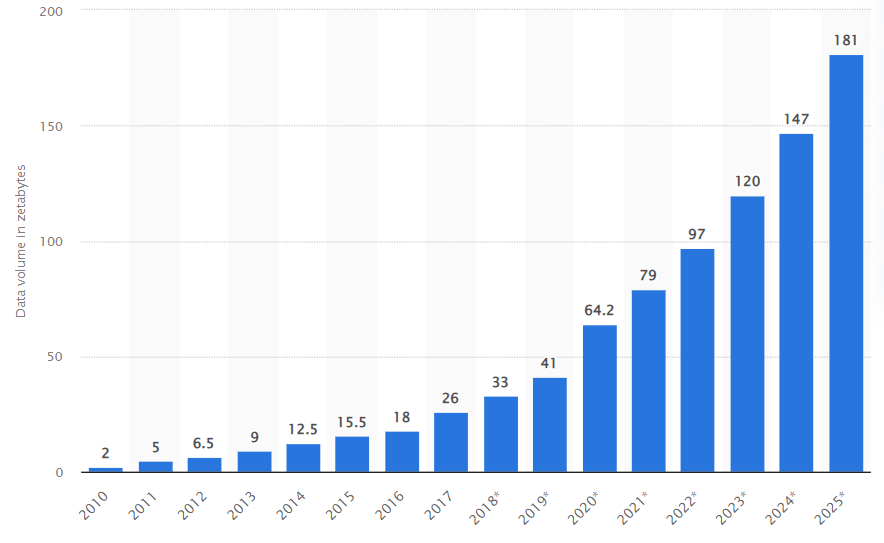
This massive increase in data can be attributed to several factors, such as the rise of electronic health records (EHRs), imaging tests, patient-generated health data (PGHD), and wearable devices that track vital signs. As more people seek medical care or participate in wellness programs, the amount of data generated will continue to grow.
Some of the data is structured, like names, addresses, and credit card numbers, and some of the data volume comes from unstructured data, like patient imaging which is generally harder to process and analyze.
Managing all this information presents a significant challenge for healthcare providers who need to ensure its accuracy and accessibility while maintaining patient privacy. This is where hyperconverged infrastructure comes into play. By consolidating storage and computing resources into a single system with built-in redundancy features, HCI provides an efficient solution for handling vast amounts of complex medical information securely.
How Can Health Clinics & Physician Offices Benefit From HCI Healthcare IT Services?
Hyperconverged storage is revolutionary in the healthcare industry. Health clinics and physician offices can benefit from HCI in many ways. One of the most significant benefits is that it simplifies IT operations. With HCI, there is no need to manage separate silos for storage, networking, or servers. Everything is integrated into a single system.
Nfina’s HCI also offers better data protection than traditional IT infrastructures. Healthcare data security has always been a concern since patient records contain sensitive information such as medical history and personal details. With built-in redundancy features, an HCI system ensures that critical data remains available even if one component fails.
Utilizing hyperconverged storage helps reduce costs associated with managing multiple systems while enhancing performance speed due to its high-speed interconnectivity between the nodes in the cluster.
In summary, using hyperconverged storage healthcare IT solutions provide health clinics and physician’s offices with simplified management of IT operations, scalability options, and enhanced cybersecurity measures against threats while reducing overall cost by consolidating multiple systems into one unified solution that increases efficiency across all departments involved within healthcare facilities.
Benefits of Using Hyperconverged Infrastructure at Nfina as your IT Healthcare Solution
One of the main benefits of using Nfina’s hyperconverged storage in healthcare is expandability. Each year, as patient data continues to grow exponentially, it is important for healthcare organizations to have a system that can easily adapt to changing needs. Nfina’s HCI allows for seamless expansion without disrupting operations or causing downtime.
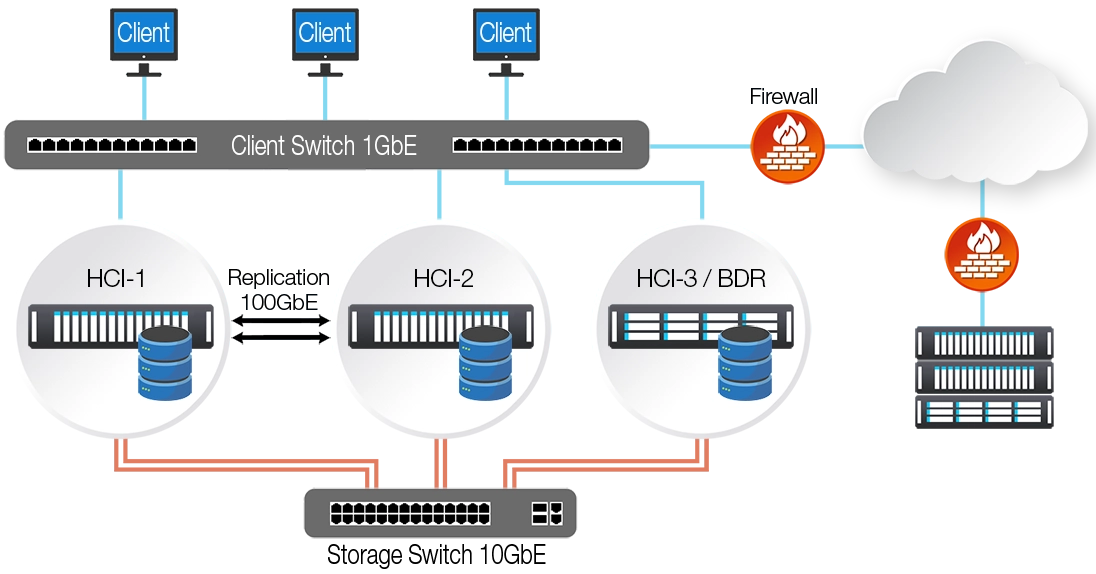
Another advantage to Nfina’s HCI is data redundancy stored in multiple locations. Here you will see a 3-node system that is typically used for healthcare IT solutions due to the amount of data obtained and the security needed to meet HIPPA regulations. With Nfina-Store™, data is stored in multiple locations on-site and off-site. If supports Active-Active failover so if one HCI goes down the other HCI automatically takes over. Data is also stored at multiple off-site locations to take over as needed. Nfina-Store™ also comes with Nfina-View™ management and monitoring software that supplies unlimited snapshots and rapid failover making sure no data is lost and no downtime occurs – which is essential in the healthcare setting. For added business continuity, Nfina-View™ also offers failover testing to make sure your system is always on-guard.
A third benefit is increased performance and faster access times for critical applications such as electronic medical records (EMRs). With Nfina’s HCI only data that has changed is saved to the servers so as to not slow down the system with data that does not need to be over-written. This means physicians can quickly access patient information during appointments, which ultimately leads to better care outcomes.
Security is another key benefit of HCI in healthcare. By consolidating all data onto one platform, IT teams can better secure patient information while reducing vulnerabilities across multiple systems.
Additionally, hyperconverged infrastructure reduces operational costs associated with managing separate storage hardware and servers. This enables health clinics and physician offices to allocate resources towards other areas such as improving patient care or investing in new technology.
Utilizing HCI in healthcare provides organizations with a modernized solution that offers flexibility, improved performance, enhanced security measures, and reduced operational costs – making it an ideal choice for any forward-thinking clinician or administrator looking to improve their practice’s overall efficiency.
The Future of Hyperconverged Healthcare IT Solutions
The healthcare industry is constantly evolving and adapting to new technologies, making it crucial for clinics to stay up to date to provide the best possible patient care. One technology that has been gaining traction in recent years is hyperconverged IT solutions. These solutions combine multiple IT healthcare services functions, such as storage, computing, networking, and virtualization, into a single integrated system. This streamlined approach offers numerous benefits for clinics, including improved efficiency, cost savings, and enhanced patient care.
Increased Adoption Rates: One of the main trends we can expect to see in the future is an increase in adoption rates of hyperconverged IT healthcare solutions within the healthcare industry. As more and more clinics realize the benefits of this technology, they will be eager to implement it into their own systems. In fact, according to a report by MarketsandMarkets Research Private Ltd., the global market for hyperconverged infrastructure is expected to reach $17 billion by 2023.
Integration with Advanced Technologies: Hyperconvergence also opens opportunities for integration with advanced technologies such as artificial intelligence (AI) and Internet of Things (IoT). With AI-powered analytics capabilities built into these systems, clinicians will have access to real-time data insights that can aid in making accurate diagnoses and personalized treatment plans for patients. Additionally, IoT devices can be seamlessly integrated into a hyperconverged environment to monitor patient health remotely and automatically send updates back to medical professionals.
Enhanced Cybersecurity Measures: As electronic health records become more prevalent in the healthcare industry, ensuring their security becomes increasingly important. Hyperconverged IT solutions offer enhanced cybersecurity measures with centralized control over all aspects of data management. This includes encryption protocols that protect sensitive patient information from cyber threats.
Improved Interoperability: Interoperability refers to the ability of different systems or software to work together and share data seamlessly. Hyperconverged IT solutions are designed to integrate various technology components, making it easier for different systems to communicate with each other. This will ultimately lead to improved care coordination among healthcare providers, resulting in better patient outcomes.
How Can Health Clinics & Physician Offices Get Started with Nfina’s Hyperconvrged Storage?
Getting started with Nfina’s hyperconverged infrastructure (HCI) is not as daunting as it may seem. The first step for clinics and physician offices would be to assess their current IT setup and identify areas that can benefit from HCI. This includes evaluating data storage, processing power, network capabilities, and security protocols.
When making a decision, it is important to consider factors such as amount of data you currently have, how much your business data will grow, redundancy needs, support services, pricing models, and implementation timelines.
After selecting an HCI solution, it is time for deployment. Nfina will provide a Managed IT services for healthcare member to provide assistance in setting up the hardware and software components of the infrastructure. They will also ensure proper training for staff members, so they can effectively operate the new system.
Maximizing benefits from HCI implementation in healthcare settings requires careful planning involving compliance regulations like HIPAA requirements on securing ePHI – electronic protected health information- over networks by using VPN connections rather than public internet access where possible. Nfina will make sure all of those key regulations are met.
Implementing hyperconverged storage can streamline processes across multiple departments within a clinic or physicians’ office while enhancing data security at scale. With proper planning during deployment followed by robust maintenance policies set up going forward this technology is poised to help you manage your healthcare data more efficiently.
Sources
[1] Statista

At Nfina, our Eco-Friendly Solutions make it easy for our customers to achieve a lower carbon footprint and play a positive role in bringing about a sustainable future. We design technologies and products to help people understand their impact and actions better.
Nfina’s Hybrid Cloud and Hyperconverged solutions provide energy efficiency by using high-density, lower-power VMs enabling our customers to scale their digital transformations sustainably by optimizing space, reducing power consumption, and lowering cooling and maintenance costs. Nfina is taking a leadership role in doing what it takes to tackle climate change.
Nfina has been carbon neutral for our operations since opening in 2012.