
Nfina’s Hybrid Cloud
Nfina’s Hybrid Cloud
Nfina’s Hybrid Cloud is a fully managed solution designed to protect and ransomware proof your business. Nfina makes it easy to maintain and recover company data in the event of data loss through software or hardware failure, or even from a ransomware attack. Nfina’s Hybrid Cloud solution combines the entire process into a single service. Storage, design, testing, monitoring, failover, reporting and more. We maintain copies of critical data on-site and offsite. Redundancy ensures information is insulated and always available for recovery and minimizes downtime.
Nfina’s Hybrid Cloud is focused on Infrastructure as a Service (IaaS) that includes on-prem edge compute and uses a private cloud as opposed to the public cloud. Most big-box vendors and cloud providers define IaaS as a cloud computing service. Nfina doesn’t limit our definition of IaaS to the cloud. With Nfina’s Hybrid Cloud, the on-prem hardware lease is included in the service eliminating the burden of large, upfront investments. Nfina’s Hybrid Cloud is the perfect solution to move your IT infrastructure forward with affordable fixed monthly billing, Op-Ex savings and no upfront Cap-Ex spending tying up capital.
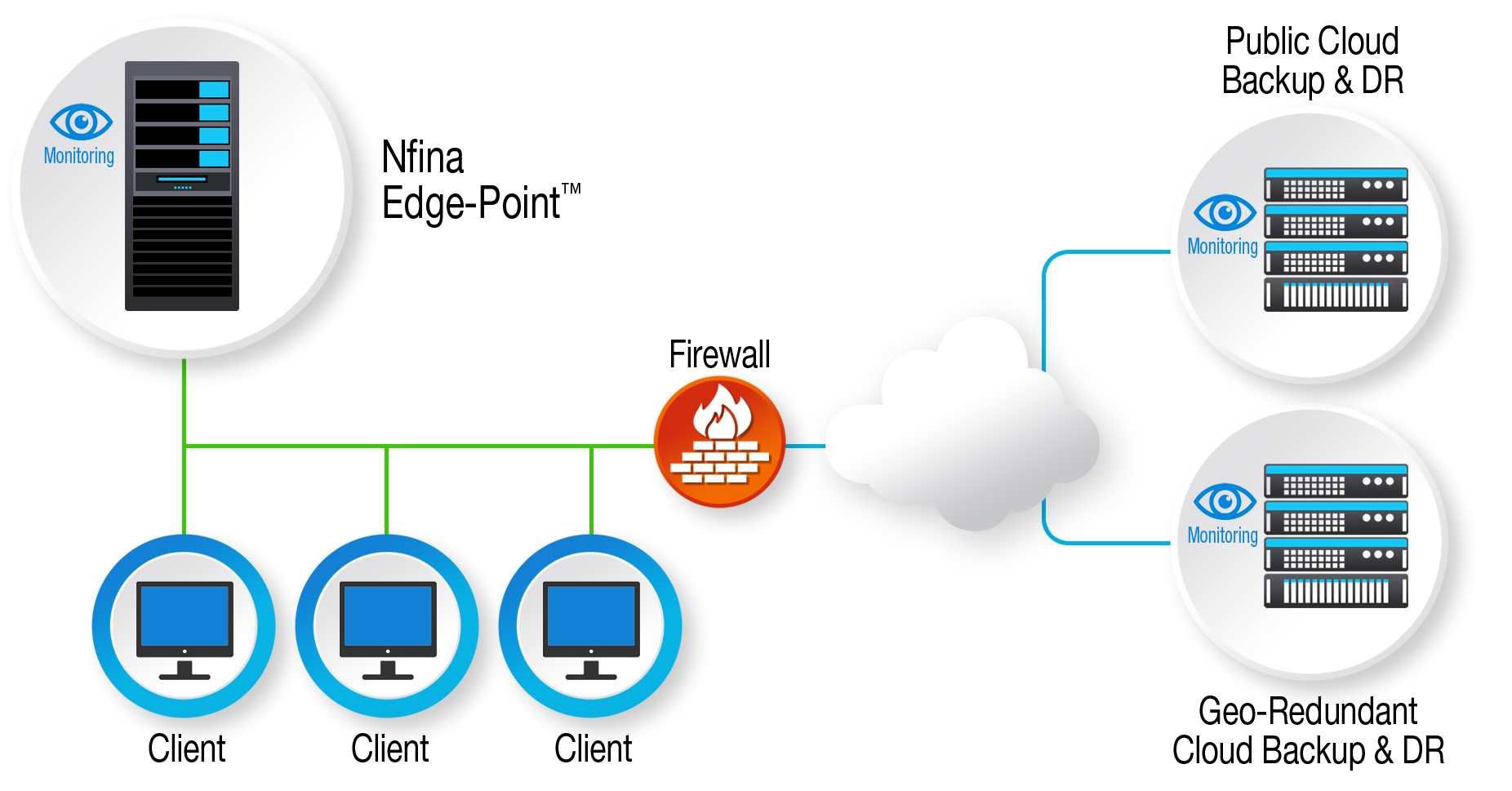
Affordable Disaster Recovery for Business Continuity
Hybrid Cloud Data Protection solutions from Nfina offer several benefits over the public hyper-scale cloud without the costs and complexity. In fact, Nfina’s customers can save up to 50% more with Nfina’s hybrid multi-cloud solutions than with public hyper-scale cloud solutions.
With Nfina’s Hybrid Cloud data protection solutions, your data and applications can be recovered instantly in case of data loss. In the event of a ransomware attack, a software or hardware failure, sabotage, a natural disaster, or an employee error, your operations can be thrown off course, with costly consequences.
Nfina’s Hybrid Cloud Managed Services Included in End-to-End Solution
Nfina’s Hybrid Cloud Managed Services guarantee users both performance and peace of mind, with geo-redundant backup and disaster recovery. Our knowledgeable engineers provide confidence that a qualified team oversees the workload, while also allowing businesses to customize their own multi cloud solution. As an extra bonus, our service saves you time via cost reductions and a simple-to-predict budget.
Your Disaster Recovery Plan is Complete with Nfina’s Hybrid Cloud
Do not waste your time worrying about how you will recover from natural disasters or how long it will take for business to resume operations after a cyberattack. Our team is prepared to handle any unexpected event quickly and efficiently. Nfina provides built-in backup and disaster recovery capabilities to keep your platform running smoothly and efficiently.
Nfina provides a hybrid cloud data protection solution that merges local VMs with remote, off-site storage. Cluster-to-cluster replication ensures that your information is accessible and consistent. Nfina’s professionals will collaborate with your team to construct the IT framework including guidelines, standards, processes, systems, metrics, and upkeep. This helps your enterprise manage risk and expenses, maintain control and compliance, and reach business objectives.
Hybrid cloud architecture is a revolutionary approach to cloud computing that combines the best of public and private cloud models. As businesses increasingly rely on digital technologies to operate, there has been a shift towards utilizing hybrid cloud solutions to meet their ever-evolving needs. Nfina’s hybrid cloud offers a flexible and scalable solution that allows organizations to seamlessly integrate their existing IT infrastructure with the benefits of the cloud.
Hybrid Cloud Architecture
At its core, hybrid cloud architecture consists of two main components – a private on-premise infrastructure and a public off-premise infrastructure. The private infrastructure typically includes servers, storage, and networking equipment located within an organization’s own data center or colocation facility. This allows for complete control over sensitive data and applications while maintaining the security and compliance standards set by the business.
On the other hand, the public infrastructure is provided by third-party service providers such as Amazon Web Services (AWS) or Microsoft Azure. These providers offer a wide range of services including virtual machines, storage, databases, and more that can be accessed over the internet. By leveraging these services from multiple providers, businesses can benefit from cost savings, increased scalability, and improved redundancy.
One of the key advantages of hybrid cloud architecture is its flexibility. Organizations have the freedom to choose which workloads are hosted in their private infrastructure versus those in the public cloud based on performance requirements and cost optimization strategies. For instance, highly sensitive data can be stored in a secure private environment while less critical applications can be hosted in a more cost-effective public setting.
Scalability is another significant benefit offered by hybrid clouds. With this model, businesses can easily scale up or down depending on their resource demands without having to make significant investments in hardware or software. This makes it an ideal solution for seasonal workloads or sudden spikes in traffic.
Additionally, hybrid clouds provide enhanced disaster recovery capabilities compared to traditional single-cloud solutions. In case of any system failures or outages in one environment, organizations can quickly switch to the other environment without experiencing any significant downtime.
Nfina’s hybrid cloud solution offers a robust architecture that combines the best of both worlds – the control and security of a private infrastructure with the flexibility and scalability of public cloud services. By leveraging this model, businesses can optimize their IT operations, reduce costs, and improve their overall efficiency. Contact Nfina today to learn more about how our hybrid cloud can benefit your organization.
Hybrid Cloud Management
There are several factors that need to be considered while implementing effective hybrid cloud management:
1) Integration:
The first step towards successful hybrid cloud management is ensuring seamless integration between different environments. This requires selecting compatible technologies that can communicate with each other effectively.
2) Automation:
As the complexity of managing multiple clouds increases, automation becomes essential for streamlining tasks such as provisioning/de-provisioning resources, scaling applications based on demand, and optimizing workload distribution.
3) Security:
Data security is a critical concern for any organization operating in a hybrid cloud environment. A robust security framework should be implemented across all platforms to protect sensitive information from potential threats.
4) Monitoring:
Hybrid cloud management also involves continuous monitoring of all resources across different environments. This ensures proactive identification and resolution of any issues that may arise. Nfina uses a bespoke monitoring software, Nfina-View.
5) Cost Optimization:
Another key aspect of effective hybrid cloud management is cost optimization. By constantly analyzing resource usage patterns and identifying areas for improvement, organizations can minimize their operational costs.
To implement these strategies successfully, many companies are turning towards third-party tools specifically designed for managing hybrid clouds. These tools provide centralized visibility into all environments, simplifying the management process and allowing for better decision-making.