
Optimize Data Protection with Enterprise Hybrid Cloud Solutions
How Much Will You Save with Nfina’s Hybrid Cloud?
Enterprise Hybrid Cloud Solutions
Nfina 9424R-HC
5th Generation Intel® Xeon® Scalable Processor, Hybrid Cloud
with High Availability

MSRP Starting at
$18519.61
- Form Factor: Twin 2U rackmount dual-socket servers
- Memory: 16 DIMM slots, 4TB max memory capacity (per chassis)
- Drive Bays: 24x 2.5″ hot-swap drive bays (per chassis)
- Ethernet: 2x 10GbE LAN (100/1000/10000) standard (per chassis), other options available
- PCIe Slots: 4x PCIe® Gen5 x16 FLFH slots, 2x PCIe® Gen5 x8 HLFL slots (per chassic)
- Included Software: Nfina-View Monitoring, and Nfina-Store
- Warranty: 5 years
Nfina 9412R-HC
5th Generation Intel® Xeon® Scalable Processor, Hybrid Cloud
with High Availability

MSRP Starting at
$18518.98
- Form Factor: Twin 2U rackmount dual-socket servers
- Memory: 16 DIMM slots, 4TB max memory capacity (per chassis)
- Drive Bays: 12x 3.5″ hot-swap drive bays (per chassis)
- Ethernet: 2x 10GbE LAN (100/1000/10000) standard (per chassis), other options available
- PCIe Slots: 4x PCIe® Gen5 x16 FLFH slots, 2x PCIe® Gen5 x8 HLFL slots (per chassic)
- Included Software: Nfina-View Monitoring, and Nfina-Store
- Warranty: 5 years
What is an Enterprise Hybrid Cloud?
An Enterprise Hybrid Cloud is an innovative approach towards advanced IT infrastructure systems where an organization seamlessly integrates public and private cloud systems. The complexity of the infrastructure systems is determined by the organization’s need to maintain control over sensitive data. The design permits an organization to utilize on-premises resources for central application systems that need stringent security requirements and compliance, while also accessing the scalability and cost-worthiness offered by public cloud service for less sensitive workloads or for scenarios where demand is high.
Components of an Enterprise Hybrid Cloud
Private Cloud Infrastructure:
A private cloud is an on-premises data center that an organization owns and operates. This includes servers and storage systems paired with networking gear and virtualization software that provide secure hosting for critical applications and sensitive data. The private cloud is completely secure and allows enterprises total resource control.
Public Cloud Infrastructure:
A Public Cloud Infrastructure is owned and operated by third-party providers like Nfina, Microsoft Azure, or Google Cloud Platform (GCP). Public Clouds allow for highly scalable computing resources and access over the Internet on a pay-per-use plan. Public Clouds allow enterprises an amazing amount of operational flexibility and provide the ability to rapidly “turn” IT resources on or off depending on strategic needs.
Hybrid Cloud Management Platform:
A hybrid cloud management platform provides a single interface that allows enterprises to manage both private and public clouds. This platform allows IT to oversee resource use, streamline tasks and resource upping/downing, cost management, and performance management across the hybrid cloud resources from a central interface.
Integration Technologies:
Technologies that facilitate integration are vital for enabling applications and workloads to flow smoothly from one domain to another within and between private and public clouds. APIs, containers (Docker and Kubernetes), and applications such as Apache Kafka and RabbitMQ are some examples.
Virtual Private Network (VPN):
VPNs secure gateways created over the internet to connect an organization’s on-premises set up to public cloud resources. In a hybrid cloud scenario, this permits sensitive information to cross different environments on the cloud without being decrypted, ensuring a secure transfer of unmasks.
Hybrid Cloud Security Solutions:
Moving to hybrid clouds places strong demands on the organization’s security infrastructure. The use of cloud security tools such as firewalls, intrusion detection systems, and data encryption can mitigate risks. Firewalls and intrusion detection systems secure sensitive data through external threat detection.
Disaster Recovery and Business Continuity:
These mechanisms ensure that essential applications and information are not just stored, but readily available, or ‘hot’ in the event of a disruption. With data replication between the private and public clouds, these solutions offer enterprises high availability and enhanced durability.
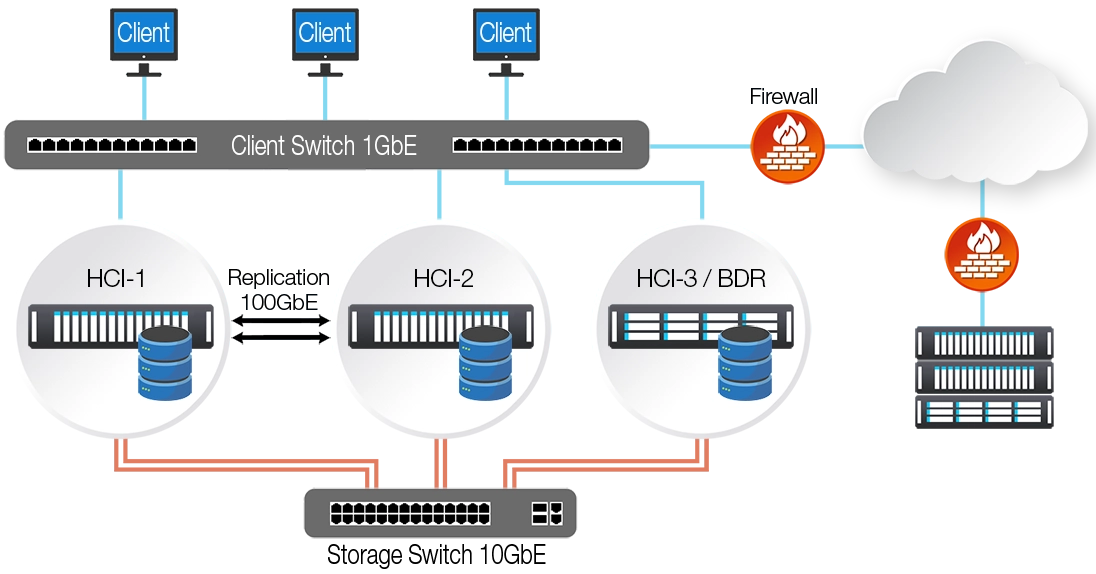
A Typical Enterprise Level 3 Node Hybrid Cloud Architecture
How Does Enterprise Hybrid Cloud Data Protection Work in Different Environments?
Hybrid cloud setups are extremely flexible, allowing organizations to customize configurations depending on workloads, budgets, and regulations. Some common hybrid cloud models are described below and their possible use cases:
On-Premises/Private Cloud Environment:
In this situation, the business operates its own servers or data center, as well as clouds infrastructure, for private setup. With enterprise hybrid cloud setup, the business is also able to tap into public cloud services to get additional resources. This gets more accessible and cost-efficient as businesses pay only for usage referenced from a public cloud service.
Public Cloud Environment:
Some businesses prefer to operate primarily on the cloud, and public cloud infrastructure. However, some apps or data is also sensitive and needs to be kept on-premises due to security, or compliance laws. An enterprise hybrid cloud setup allows these businesses to keep cloud workloads on-premises, while leveraging the scalability and availability of the public cloud to run other workloads.
Multi-Cloud Environment:
Modern organizations use several public clouds for different functionalities, like AWS for storage and Azure for analytics. Here, the enterprise hybrid cloud acts as a centerpiece, allowing businesses to seamlessly manage and shift their workloads from one cloud to another.
Disaster Recovery/Backup Environment:
Being prepared for a disaster and having backup systems in place are crucial elements of any continuity strategy. With a hybrid cloud solution for enterprises, you can replicate your critical data and applications to a public cloud’s secondary site for disaster recovery. This means that if a disaster strikes, a business can recover systems and continue operations almost immediately.
Benefits of Hybrid Cloud Data Protection
Hybrid cloud data protection is a strategy that combines on-premises and cloud-based or off-premises data management solutions to protect data and applications from loss, corruption, or other security risks. This approach allows organizations to leverage the benefits of both local and remote backup services, providing enterprise-level data backup and disaster recovery capabilities.
Nfina’s hybrid cloud solutions can be customized based on the organization’s requirements. It can include a mix of local backup storage options such as HCI, NAS, or JBODs as well as geo-redundant backup in a private cloud, data center, co-lo, or even a branch location.
Some of the key benefits of hybrid cloud data protection include:
Scalability:
Hybrid cloud data protection allows businesses to scale their data backup resources as per their needs without any investment in hardware or infrastructure.
Accessibility:
Cloud-based backup solutions allow remote access to critical data, enhancing business continuity and productivity.
Cost-Effective:
Hybrid cloud data protection allows businesses to save costs by eliminating the need for expensive hardware and data center infrastructure.
Security:
Complies with industry-leading security standards, ensuring better data protection against malware or cyber threats.
Disaster Recovery:
Hybrid cloud data protection enables businesses to recover data quickly and efficiently after a disaster, ensuring minimal downtime.
To ensure effective hybrid cloud data protection, Nfina will help you identify your data backup needs, evaluate your IT infrastructure, and choose the right off-premises redundant solution. Nfina’s customized hybrid cloud data protection solution will provide you with a secure, reliable, and cost-effective backup and DR solution that is flexible enough to adapt to your changing business needs.
Maximize Efficiency & Cost Savings With Nfina’s Enterprise Hybrid Cloud Solutions
As a leading hybrid cloud solutions provider, Nfina offers cutting-edge technology to help businesses maximize efficiency and cost savings. By utilizing Nfina’s Enterprise Hybrid Cloud Solutions, companies can seamlessly integrate their on-premise infrastructure with cloud services, creating a flexible and scalable IT environment. This allows for increased agility in responding to changing business needs while reducing operational costs associated with maintaining physical hardware.
With Nfina’s reliable and secure platform, organizations can easily migrate workloads between private and public clouds, optimizing performance without compromising data security. Additionally, the built-in automation features like Nfina-View streamline processes and improve resource utilization, further enhancing overall productivity. Trusting in Nfina as your hybrid cloud solutions provider ensures that your business stays ahead of the curve in today’s competitive market landscape.
With robust features such as automated backups, disaster recovery capabilities, multi-cloud support, and real-time hybrid cloud analytics, businesses can leverage Nfina-View with their data management processes to drive better decision-making outcomes and stay competitive in today’s fast paced data retrieval and storage.
Hybrid cloud data management is a crucial aspect of modern IT infrastructure, allowing organizations to seamlessly integrate and manage data across both on-premises and cloud environments. This approach enables businesses to leverage the benefits of both private and public clouds while ensuring maximum flexibility, scalability, and security. Hybrid cloud infrastructure management plays a key role in orchestrating data flows, optimizing workloads, automating processes, and maintaining compliance with regulatory requirements.
By effectively managing data in a hybrid cloud environment, organizations can streamline operations, enhance business agility, improve decision-making capabilities, and drive innovation. With the right tools and strategies in place for hybrid cloud data management, businesses can unlock the full potential of their IT resources and stay ahead in today’s rapidly evolving digital landscape.
Nfina is a highly skilled hybrid cloud architect who specializes in crafting dynamic hybrid cloud solutions for businesses of all sizes. With our expertise and experience, we can analyze your organization’s specific needs and requirements to design a customized solution that seamlessly integrates both public and private cloud environments. By leveraging the latest technologies and best practices, Nfina ensures that your infrastructure is optimized for performance, scalability, and cost-effectiveness. Whether you need to migrate existing workloads to the cloud or build a new architecture from scratch, Nfina has the knowledge and skills to plan and implement a solution that meets your unique business goals. Trust Nfina to be your trusted partner in navigating the complexities of the dynamic hybrid cloud landscape.
Enterprise Hybrid Cloud FAQ
As enterprises continue to adopt hybrid cloud solutions, questions and concerns about this approach to cloud computing are bound to arise. In this section, we aim to address some of the most frequently asked questions about hybrid cloud.
1. What is a hybrid cloud?
A hybrid cloud is a combination of two or more different types of clouds – typically private and public clouds – that work together in an integrated manner. This allows organizations to leverage the benefits of both types of clouds and achieve greater flexibility, scalability, and cost-effectiveness.
2. How does data storage work in a hybrid cloud?
In a hybrid cloud environment, data can be stored in either the private or public cloud depending on its sensitivity level and usage patterns. For example, highly sensitive data can be stored in the private cloud for enhanced security while less sensitive data can be stored in the public cloud for easier accessibility.
3. Can I control where my data is stored?
Yes, one of the key advantages of a hybrid cloud is that it provides organizations with greater control over their data placement. Companies can choose which applications and data reside in which environment based on their specific needs.
4. Is it more expensive to implement a hybrid cloud compared to other options?
It may seem like implementing multiple clouds would lead to higher costs, but in reality, adopting a hybrid approach can actually save organizations money. By utilizing both private and public clouds for different purposes, companies can optimize their spending based on their needs rather than relying solely on one type of environment.
5. Is security compromised when using a hybrid cloud?
Security is always top-of-mind when it comes to managing sensitive business data. The good news is that with proper planning and implementation strategies, security risks can be minimized in a hybrid cloud environment just as they are managed in any other IT infrastructure.
6. How does integration between private and public clouds work?
Integration between the two environments varies depending on the specific needs and objectives of the organization. In most cases, integration is achieved through APIs and other software tools that enable communication and data transfer between the two environments seamlessly.
How Much Will You Save with Nfina’s Hybrid Cloud?
Other Hybrid Cloud Solutions
