Tower Servers: Affordable Business Performance
High performance, low cost Tower Server
solutions with a standard 5-year warranty.
Nfina 4408T
5th Generation Intel® Xeon® Scalable Processor Dual-Socket Tower Server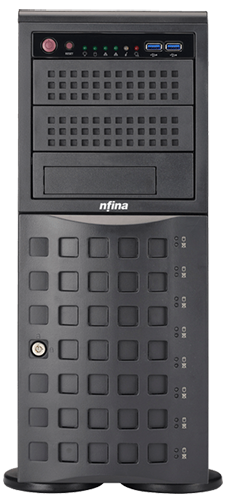
MSRP Starting at
$5088.13
- Form Factor: Tower, dual-socket server
- Processor: 5th Generation Intel® Xeon® Scalable Processor
- Memory: 16 DIMM slots, 1.5TB max memory capacity
- Drive Bays: 8x 3.5″ or 2.5″ hot-swap drive bays
- Optical Drive: 48x CD-RW / 24 x DVD +/-RW (optional)
- Ethernet: 2 x 10GbE LAN (100/1000/10000) standard, other options available
- PCIe Slots: 4 x PCIe® Gen5 x16 FLFH slots, 2 x PCIe® Gen5 x8 FLFH slots
Nfina 144T
Mid Tower, Desktop Tower Server
Single-Socket

MSRP Starting at
$1802.64
- Form Factor: Mid-tower, single-socket server
- Processor: Intel® Xeon® Processor E-2400 Series
- Memory: 4 DIMM slots, 128GB max memory capacity
- Drive Bays: 4x 3.5″ SSD/HDDs – or – 4x 2.5″ SSD/HDDs – or – 8x 2.5″ SSD/HDDs
- Optical Drive: 1x 5.25″ DVD-ROM SATA drive included, 24X DVD-RW
- Ethernet: 2x 1GbE LAN ports standard
- PCIe Slots: 2x PCIe Gen5 x8 FHFL slots, 2x PCIe Gen 4 x4 FHFL slots
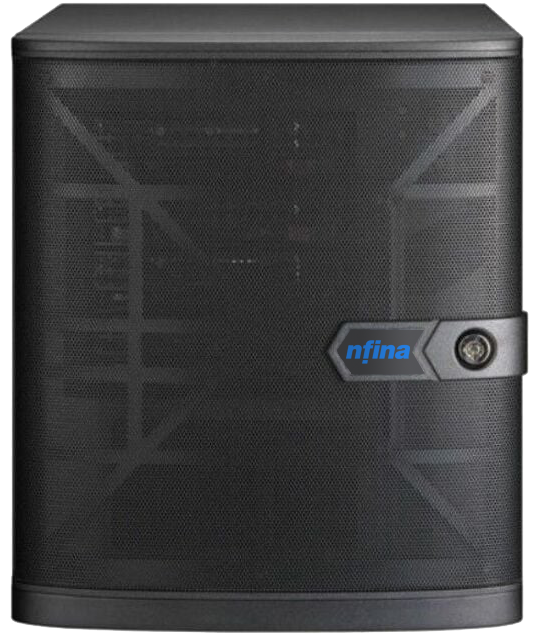
Nfina 144-MT
Compact Mini Tower
Single-Socket
MSRP Starting at
$1764.47
- Form Factor: Compact mini-tower, single-socket server
- Processor: Intel® Xeon® Processor E-2400 Series
- Memory: 2 DIMM slots, 64GB max memory capacity
- Drive Bays: 4x 3.5″ hot-swap drive bays
- Ethernet: 2x 1GbE LAN with Intel® i210
- PCIe Slots: 1x PCIe® Gen5 x16,
1x PCIe® Gen4 x4
Same Day Quoting
Nfina’s AI-based configurator and in-house staff generate same-day quotes for Hybrid Cloud and components. Configure it yourself or if you need help, contact our office and we will assist you.
3 to 5 Day Shipping
We stock the components to build Nfina’s Hybrid Cloud solutions and other systems. Orders with in stock componants will ship in 3 to 5 business days.
5-Year Warranty and Superior Customer Support
Nfina’s products carry a 5-year warranty and we support everything that we sell. We provide 24/7 remote tech support for you and your clients and Nfina Engineers are available to assist you when you are ready to install at your client’s location.
Nfina is an industry leader in producing small and midsize business servers.
Nfina’s tower servers are top-of-the-line pieces of equipment designed to meet the needs of small and midsize businesses. They are compact, powerful, and highly reliable, making it an ideal choice for any business looking to upgrade their server system.
These tower servers are engineered with advanced technology that ensures robust performance and scalability, making them ideal for businesses looking to streamline operations without compromising on power.
With options that support multiple processors and a variety of configurations, Nfina’s tower servers can easily adapt to the evolving demands of growing companies. Their user-friendly design allows for effortless installation and maintenance while also providing ample storage capacity to handle everything from data management to application hosting.
Nfina prioritizes energy efficiency in our products; these tower servers not only deliver exceptional computing capabilities but do so while minimizing operational costs, an essential factor for small and midsize businesses striving for sustainability alongside profitability.
Characteristics of a Server Tower
A server tower is built in a vertical chassis that echoes the shape of a traditional desktop. This design has made it a staple in many office settings, prized for its blend of compactness, built-in power, and ease of use. In the following paragraphs, we will highlight the features that give server towers their edge over other server types.
- Size and Form Factor
A tower server’s biggest advantage is its footprint. It doesn’t need the rails and cabinets of rack servers, nor the specialized enclosures of blade systems. Instead, it can sit on a desk, a shelf, or on the floor, which is a welcome trait in smaller offices and home setups that have already claimed the closet for a printer.
Fans channel air from bottom to top more efficiently, keeping vital components cooler. This is why a tower can handle sustained workloads, such as databases or virtualization, without needing aftermarket cooling or extra sockets.
- Scalability
Tower servers shine in scalability, easily integrating more hardware to keep pace with growing business demands. They come with multiple expansion bays for extra disks, DIMM slots for more memory, and PCI slots for additional NICs, all of which can be added on the fly, sparing you the cost of a new chassis.
Processing muscle isn’t limited either; most modern towers can house a second CPU, which means they can juggle demanding apps and virtual machines without missing a beat.
- Versatility
Server towers are the all-purpose tools of the data room. They can be dedicated file storage, host corporate websites, route email, or run a hypervisor, adapting to whatever role the organization requires.
The same flexibility applies to software, since they support a range of operating systems—Windows Server for Microsoft shops, any flavor of Linux for open-source stacks, or UNIX-based systems like FreeBSD for legacy apps.
- Reliability
Dependability isn’t optional for servers supporting mission-critical workloads; it’s mandatory. Tower servers are constructed with enterprise-grade components, each rated for nonstop operation under heavy load.
The enclosed case and planned airflow keep components cool, reducing the likelihood of thermal stress and failure. The result is a system you can trust to keep services running and data accessible, day and night.
- Upgradability
When technology marches forward, your server should be able to march right along with it. Tower servers are designed to welcome new hardware and software enhancements with open PCI slots, extra drive bays, and plenty of RAM slots, so you can replace aging parts without the expense and downtime of a full system buy. This pragmatic approach not only protects your budget but also stretches the working life of your infrastructure.
With a small footprint and impressive processing muscle, tower servers let small and midsize companies run essential applications and services smoothly. Their space-efficient design, room to grow, flexible configuration options, dependable performance, and straightforward upgrading path make them a smart, long-term choice for businesses that demand a sturdy and adaptable IT backbone.
Advantages of a Tower Server
Unlike traditional desktop computers that are optimized for individual use, tower servers are specifically designed for enterprise-level computing tasks, such as a file server. They feature advanced server hardware components such as powerful processors, large amounts of memory (RAM), multiple storage drives (HDD or SSD), redundant power supplies, and specialized cooling systems to ensure optimal performance and reliability.
The main purpose of tower servers for small business is to serve as the backbone of a business’s IT infrastructure while saving space not using rack servers. They act as central hubs for storing data and running critical business applications that enable daily operations. By consolidating important functions onto one device rather than having them spread out across multiple rack server machines, a server tower will help streamline processes while minimizing costs.
Potential Disadvantages
Power supply limitations: Unlike 1U or 2U servers, Tower Servers generally come with only one power supply and lack a backup to continue operations, leaving you in the dark if one fails.
Noise: Due to their design and configuration, tower servers can be quite noisy during operation. This may not be an issue for larger businesses with dedicated server rooms, but for smaller teams working in a shared office space, this constant background noise can be disruptive and distracting.
Portability: They’re less of a hassle to shift than full data center racks, but they’re heftier than blades or micro servers. If your organization must relocate servers often, be it for disaster preparedness or because you’re moving offices regularly,tower servers could become a logistical headache.
Lack of controlled environment: Setting your own Tower Server up on premises has a slight disatvantage. All maintenance and hardware issues are up to your own organization to handle, while a data center has 24/7 monitoring on all their servers, cooling lanes, and other hardware and options to keep your server up and running.
What Tower Server is right for me?
For small offices in need of efficient file storage and Active Directory management, the 144T stands out as the best tower server; its compact design and robust performance allow it to seamlessly handle essential tasks while ensuring reliable data access.
As businesses scale and demand increases, virtualization becomes a key consideration; here, the 4408T excels with its extensive expansion capabilities and powerful processing power, making it ideal for running multiple virtual machines without compromising on speed or efficiency.
Finally, for those constrained by space yet unwilling to sacrifice performance, the 114-MT emerges as the best compact tower server—its sleek form factor allows it to fit into tight environments while still delivering impressive functionality suitable for various applications. Each model represents unique advantages tailored to specific use cases within diverse operational landscapes.
Tower Server FAQ
1. How does the performance of Nfina’sTower Servers with 5th Generation Intel® Xeon® Scalable processors compare to other servers in its class, especially for budget-conscious buyers?
You can rest assured that you are getting top-of-the-line performance at an affordable price. The 5th Gen Intel Xeon processors provide significant performance improvements over previous generations, including an average of ~21% performance gain for general compute workloads compared to the 4th Gen, and an impressive up to 14x higher AI inference performance compared to the 3rd Gen. This makes Nfina servers a substantial upgrade for businesses using older 1st or 2nd generation chips, which is a common scenario in the market.
These servers provide superior ROI through 5th Gen performance gains, offering up to a 67% improvement in AI workloads, while utilizing energy-efficient, rack-optional designs that reduce initial infrastructure costs. So why settle for less when you can have a high-performing, cost-effective solution like the Nfina Tower Server?
2. What support and warranty options does Nfina offer with the purchase of a Tower Server to ensure the investment is protected long-term?
All Nfina tower servers include a 5-year limited warranty. This is notably longer than the 3-year standard offered by many competitors, potentially eliminating one hardware refresh cycle over a seven-year period. Support includes free patch management and ransomware remediation services.
3. What specific features make Nfina’s Infrastructure-as-a-Service (IaaS) solution ideal for businesses looking to enhance their disaster recovery capabilities?
The entire IaaS and Disaster Recovery as a Service (DRaaS) process is a single-vendor solution, managed through one dashboard (Nfina-View™). This eliminates the complexity of coordinating multiple vendors and includes expert, U.S.-based managed services and ransomware remediation support. In the event of a failure, the Nfina-View™ management software enables quick failover to the cloud-based backup environment, restoring data and operations within minutes, not hours or days. Rollback functionality is also available for rapid restoration from a past snapshot
4. Can you explain how Nfina’s solutions help protect my organization from ransomware attacks, and what steps do I need to take to implement these security measures?
Nfina uses Copy-on-Write technology to create read-only, point-in-time snapshots of your data. These are “immutable,” meaning they cannot be altered, encrypted, or deleted by ransomware, providing a guaranteed clean recovery point. Using the Nfina-View dashboard, administrators can perform a “one-click” rollback to a snapshot taken minutes before the attack. This restores the entire IT ecosystem in minutes rather than the days or weeks required for traditional backups.
5. What specific connectivity options do Nfina Tower Servers offer and how do they enhance my business’s data transfer capabilities?
Nfina Tower Servers offer a variety of connectivity options to enhance your business’s data transfer capabilities. Firstly, it has 2x 10GbE LAN with Intel® X710 per controller, providing high-speed and reliable connections for large amounts of data transfer. Additionally, it offers options for 25GbE, 40GbE, and even 100GbE for ultra-fast data transfer speeds.
Our servers have the option for Fiber Channel connectivity, which is ideal for businesses that require high-performance storage networking. And for remote management and monitoring, we also provide a dedicated 1GbE IPMI connection per controller. With this range of connectivity options, Nfina Tower Servers ensure that your business can handle large volumes of data efficiently and effectively.
Acy Flora – “We Trust Nfina”
Vice President/General Manager – Nfina Partner

“As an Nfina partner, we have seen first-hand the exceptional quality and performance of your products. But what truly sets Nfina apart from others is your dedication to helping us create customized solutions for our clients. Your team goes above and beyond to ensure that every Gregory customer receives exactly what they need. We also cannot stress enough the importance of your post-sales support. With Nfina, we have never had an issues or concerns about receiving prompt and efficient support. Nfina’s level of commitment and expertise has been unmatched by any other company we have worked with.”
Frank Cox – “Love Nfina”
Owner – Nfina Partner
“I like the fact that I cannot only rollback my servers quickly, but I can failover to another server within minutes. The cost savings of being able to run either on my own campus or to a private cloud is so much more effective than Azure or AWS and more flexibility when it comes to cost on performance.”
View more case studies and testimonials
Other Nfina Server Solutions

2U Rack Servers