

What is Disaster Recovery on Cloud?
Cloud disaster recovery is a system that permits both small and medium-sized businesses and larger businesses to recover lost data, along with vital applications and components of their IT systems, after any major incident. Using cloud systems, businesses can back up important data at locations outside the customer premises and at locations accessible via the cloud.
This system provides for a failure over processes that can be automated with cloud systems and can transfer part or all the operations of the enterprise that consists of damaged systems. This cloud system causes the least interruption of enterprise operations and the least system downtime among the various DR systems.
This cloud system causes the least interruption of enterprise operations and the least system downtime among the various DR systems. Solutions often incorporate advanced solutions like continuous data protection (CDP) which ensures near real time replication of data across multiple geo-redundant locations.
How does Disaster Recovery on the cloud work?
Cloud-based disaster recovery is mostly using remote data centers that have virtualized resources to back up applications on systems and data that are important. Companies can choose their RTO (Recovery Time Objective) and RPO (Recovery Point Objective) which gives them control on setting up how fast services need to be resuming and how much data can be lost after a disaster.
When an incident occurs, automated processes will detect any interruption in a service and will trigger the backup processes. Nfina’s Hybrid Cloud employs a combination of on-site and geo-redundant off-site locations that utilize immutable backups and real time replication of assets to capture changes. The orchestration tools allow for smooth failover, moving operations from the disrupted primary location to secondary cloud-based locations. This ensures that key business functions are not disrupted.
The natural scalability and flexibility of cloud hosting allow organizations to rapidly adjust their disaster recovery needs on the fly according to evolving needs or increased workload demands during an outage, without extensive hardware investment and physical infrastructure limitations. Through a decent plan and testing with this dynamic cloud framework, businesses can maintain resilience while safeguards to valuable data remain in place.
Why does Cloud Disaster Recovery Matter?
The cost of downtime is significant as it halts income-generating activities and hinders employees’ ability to use necessary applications, documents, communication channels, and client information. When systems are not accessible, clients may encounter service disruptions, delayed response times, or inability to utilizecritical services. Even a brief period of unavailability can impact efficiency, diminish customer confidence, and detrimentally impact the company’s image.
The damage caused by data loss can surpass that of an outage. This includes a range of information, such as customer records, financial details, project files, application data, and operational history.
When backups are not dependable, recovery may be insufficient or even unattainable. To mitigate this risk, cloud disaster recovery involves regularly copying data to an off-site location and establishing secure restore points. Additionally, utilizing immutable backups adds another layer of safeguarding by preventing tampering or deletion of backup data due to ransomware attacks.
The nature of disaster recovery in the cloud has shifted due to cyberattacks. In the past, it primarily dealt with natural disasters like storms or fires, as well as technical issues such as hardware failures or power disruptions.
However, in today’s digital landscape, ransomware, malware, phishing attacks, and unauthorized entry can all cause catastrophic consequences.
As a result, a comprehensive disaster recovery plan must consider both recovery and cyber resilience. Utilizing cloud-based solutions enables companies to restore uncorrupted data from protected backup sites instead of depending on compromised systems.
What are the components of Disaster Recovery on Cloud Infrastructure?
The success of cloud disaster recovery relies on a series of interconnected elements that function in unison to safeguard data, recover systems, and maintain business operations during an outage. These elements encompass backup and replication, geo-redundant storage, immutable backups, failover and failback, and continuous monitoring. Each component serves a distinct purpose in minimizing downtime, mitigating data loss, and providing businesses with a dependable recovery solution.
The essential elements consist of:
Backup and replication:
This involve copying critical systems, applications, and data from the primary environment to cloud-based or hybrid cloud locations. The frequency of replication may vary depending on the organization’s recovery needs, with options ranging from scheduled backups to near real-time or continuous backups.
Geo-redundant storage
Is a method of storing data in multiple geographical locations. In case of an outage in one site or region, another location can be utilized for recovery, mitigating the risk of a single point of failure.
Immutable backups:
Is crucial for protecting against ransomware attacks, as they cannot be altered, removed, or encrypted within a set period of time. This allows companies to access uncorrupted recovery points when needed.
Failover and Failback:
Transferring workloads from the primary environment to a secondary cloud or recovery environment when it is disrupted, allowing operations to continue. Once the original environment has been repaired, validated, and restored, systems are returned in a process known as failback.
Ongoing monitoring and alert systems:
Should be in place to detect any backup failures, replication issues, storage concerns, hardware malfunctions, or security events. These alerts allow teams to proactively address potential problems before they escalate into major outages.
Rather than depending on a lone backup or a manual recovery method, companies have access to a well-organized system that ensures data availability, speedy application restoration, and continuity in the face of unforeseen disruptions.
Why do Small and Mid-Sized Businesses Need Cloud DR?
Small and mid-sized businesses need cloud disaster recovery because they often face enterprise-level risks without enterprise-level IT resources. Many SMBs operate with small internal teams, limited budgets, and a growing mix of technology environments that must stay available. As systems become more dependent on cloud applications, remote access, virtual machines, legacy infrastructure, and distributed locations, recovery planning becomes more difficult.
Cloud DR helps simplify this challenge by giving businesses a more reliable way to protect data, restore systems, and maintain continuity without building and managing a full secondary data center.
Key reasons SMBs need cloud DR include:
Limited internal IT resources:
Many SMBs do not have large IT teams available to manage backup schedules, recovery testing, infrastructure monitoring, and emergency response.
Increasing IT complexity:
Small and mid-sized businesses often operate with a combination of on-prem servers, cloud platforms, remote users, virtual machines, legacy systems, aging backup tools, and multiple locations.
Higher customer expectations:
Customers, employees, and business partners expect systems to remain available, even during outages or cyber incidents.
Cybersecurity threats:
Ransomware, malware, phishing, and data corruption can create disaster-level events that require fast access to clean recovery points.
Cost control:
Cloud DR helps businesses improve resilience without the expense of maintaining a fully duplicated physical recovery site.
Business continuity:
A strong cloud disaster recovery strategy helps reduce downtime, protect critical data, and keep operations moving when unexpected disruptions occur.
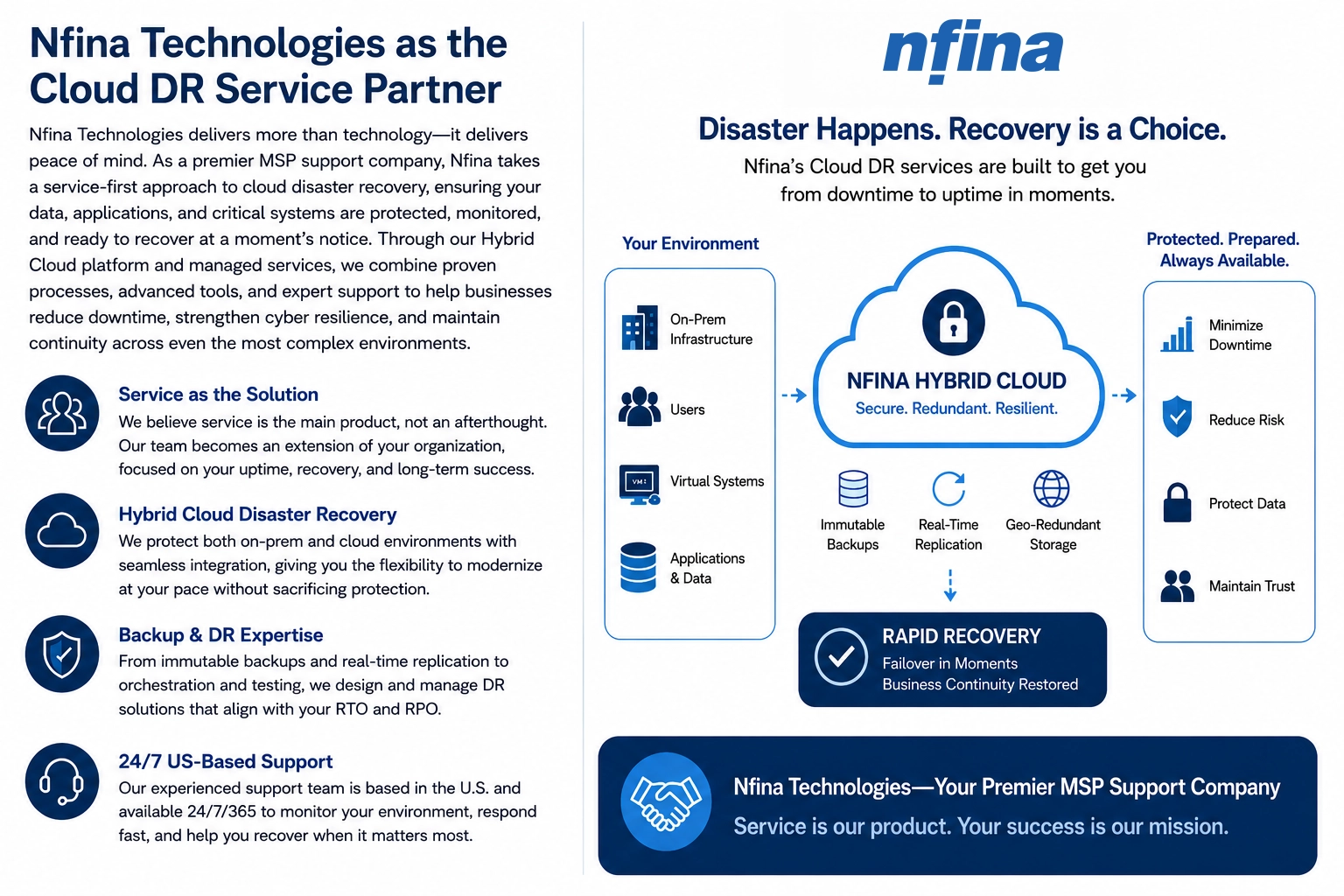
Nfina Technologies as your Cloud DR Service Partner
Nfina Technologies serves as a cloud disaster recovery service partner by helping businesses move beyond a basic backup product and toward a managed, service-first recovery strategy. For many organizations, disaster recovery is not just about storing data in the cloud; it is about having the right support, monitoring, planning, testing, and recovery expertise in place before an outage happens.
Nfina’s Hybrid Cloud approach gives businesses a way to protect both on-premises and cloud-based environments while maintaining access to professional services, Backup & Disaster Recovery support, remote infrastructure management, and ongoing recovery readiness. This makes Nfina especially valuable for small and mid-sized businesses that need resilient IT operations without the burden of managing every layer of disaster recovery on their own.
Key areas where Nfina supports cloud disaster recovery include:
Service-first disaster recovery:
Nfina treats disaster recovery as an ongoing managed service, not a one-time product installation.
Hybrid Cloud protection:
Nfina supports environments that include both on-premises infrastructure and cloud-based systems, helping businesses modernize without abandoning existing investments.
Backup and Disaster Recovery support:
Nfina helps protect critical data, applications, and workloads so businesses can recover faster after outages, ransomware, hardware failure, or data loss
Immutable backup strategy:
Immutable backups help protect recovery points from deletion, alteration, or encryption, making them especially important in ransomware recovery planning.
Geo-redundant recovery options:
Cloud-based and off-site recovery locations help reduce the risk of relying on a single site or single backup location.
Remote infrastructure management:
Nfina helps monitor and manage infrastructure remotely, improving visibility and response time when systems are unavailable or physically difficult to access.
Ongoing monitoring and testing
Disaster recovery plans must be reviewed and tested regularly. Nfina’s managed approach helps businesses maintain recovery readiness instead of waiting until an emergency to discover gaps.
Business continuity focus:
The goal is not only to restore data, but to keep operations moving, reduce downtime, and help businesses return from disruption to uptime as quickly as possible.
Together, these services position Nfina Technologies as more than a technology provider. Nfina acts as a cloud DR partner that delivers the expertise, infrastructure, and support businesses need to protect operations, recover quickly, and maintain resilience in an unpredictable IT environment.