

In today’s fast-paced digital landscape, businesses rely heavily on technology to drive their operations. As the complexity of IT environments grows, so does the need for effective management solutions. Enter Remote Monitoring and Management (RMM) tools—game-changers in the field of IT oversight. Gone are the days when organizations were tethered to on-premises software that required cumbersome installations and constant maintenance.
Cloud-based RMM solutions like Nfina-View have emerged as a vital resource, offering a streamlined way to monitor systems, manage devices remotely, and ensure optimal performance—all from anywhere with an internet connection. This shift not only simplifies processes but also enhances overall efficiency for IT teams around the globe.
Evolution of RMM Solutions: From On-Premise to Cloud-Based
Initially, the use of RMM tools was limited to on-premise servers. Businesses were always constrained to servers located at their offices. This static infrastructure setup hampered flexibility and mobility. As technology matured, it became evident that systems should be more flexible. Maintaining on-premise systems was tedious for IT departments because it aimed at solving hard IT problems such as the need for large dedicated spaces for servers and routine hardware servicing and upgrades.
The advent of cloud-based RMM offered a fresh perspective as the need for flexibility and mobility was easily met. IT systems could be managed over the internet, abolishing the need for rigid on-site servicing. Businesses became unshackled as tools could be accessed at any time from any place. Cloud-based systems eliminated many traditional barriers associated with on-premise setups. Instant accessibility and reliable infrastructure eliminated many barriers posed by on-premise setups. Automatic, seamless upgrades were available at a moment’s notice and so was reliable scaling, easing effortless business growth. This transformation helped modern business needs and IT practices today.
What are the Key Benefits of Cloud-Based RMM Solutions for IT Management?
1. Increased Flexibility and Scalability:
IT teams enjoy unmatched flexibility with Cloud-based RMM Solutions. Traditional systems lock users into particular hardware and locations, but cloud systems easily adapt and scale with shifting requirements.
Businesses can scale operations up or down at will. This includes adding new devices or users with minimal infrastructure spending. Cloud-based RMMs adjust to IT management requirements in real time, whether accommodating remote work or expanding into new offices. Furthermore, cloud RMM approaches enable organizations to meet market demands swiftly. Evolving technology brings new tools easily deployable through cloud platforms, keeping companies ahead of the curve without the need for constant upgrades. Managing disparate locations with cloud RMM is simplified, increasing efficiency. Teams are no longer drowned by the need to adapt to stagnant and rigid systems, and instead focus on growth and strategic initiatives.
2. Improved Efficiency and Productivity:
Cloud-based remote monitoring and management (RMM) solutions boost efficiency and productivity across IT operations seamlessly. Automated processes handle routine tasks remotely. Automation guarantees smooth operations and less human error scrutiny. Teams prioritize strategic initiatives over maintenance responsibilities.
Cloud-based RMM gives organizations greater visibility into their infrastructure, but monitoring tools are most effective when supported by experienced professionals who can interpret alerts, resolve complex issues, and improve the underlying environment. Nfina’s Professional Services provide assistance with endpoint management, network security, patching, application management, backup and disaster recovery, and ongoing server and storage administration.
4. Cost Savings and ROI:
Cloud-based RMM solutions clearly save costs. The legacy systems of IT management require large upfront investments in hardware and software licenses. Cloud-based solutions, on the other hand, utilize a subscription-based model which allows predictable monthly costs and no hidden maintenance charges. Nfina’s independant on-sight hyperscalers will greatly benefit ROI in terms of less downtime and interruption in services. In addition, businesses can scale cloud services up or down based on demand. Companies no longer need to reinvest in infrastructure during peak workloads.
5. Enhanced Security and Disaster Recovery:
Today’s IT management greatly benefits from the robust cybersecurity cloud-based RMM systems offer. Organizations need these systems now more than ever due to the increase in cyber threats, as organizations need to not only secure their data, but comply with regulated procedures. These systems, as mentioned previously, defend cyber threats using advanced encryption, multi-factor authentication, and frequent updates. This sensitive data protection systems help secure information from cyber threats.
Cloud-based RMM systems also help IT management streamline their disaster recovery plans. Businesses store data off site, making data instantly accessible in case of an incident. As such, businesses can restore operations while minimizing downtime. This sophisticated combination also helps ease IT professionals’ minds, as with these disaster recovery options, strategizing becomes more of a focus than a constant battle against threats, data, and unforeseen events.
6. Real-Time Monitoring and Alerts:
The way real-time monitoring RMM changes IT management is significant. With cloud RMM, businesses can continuously monitor and manage their systems. With such systems in place, any issues can be detected and resolved nearly instantaneously. This minimizes downtime and enhances productivity. Alerts are especially important in this regard. The IT team is promptly notified of any unusual network traffic or hardware issues, allowing intervention before minor problems turn into significant shutdowns.
Accessibility of real-time features is the most appealing. Monitoring can be done anywhere, whether teams are in the office or remote. This level of assurance not only bolsters operations but also fosters confidence in the reliability and stability of their IT infrastructure. Adopters of such features are surely tech hurdle free.
With Nfina-View’s summary view, you can see the health of your IT ecosystem at a glance. Quickly view zones, clusters, and node details such as status, IP address, uptime, memory health, CPU utilization, memory and DiskPool information. Hardware details provides information on the health of the power supplies, fans, motherboard voltages, and hard drives. Storage Pool details provide information for the storage pool status, capacity, Zvols, datasets, read cache, snapshots, and clones.
Network details display the host name and interface details such as IP address, MAC address, speed, model, Tx/Rx errors, drops, and status. All sensor readings are reported, and any errors trigger alerts can be set to notify administrators of a potential issue.
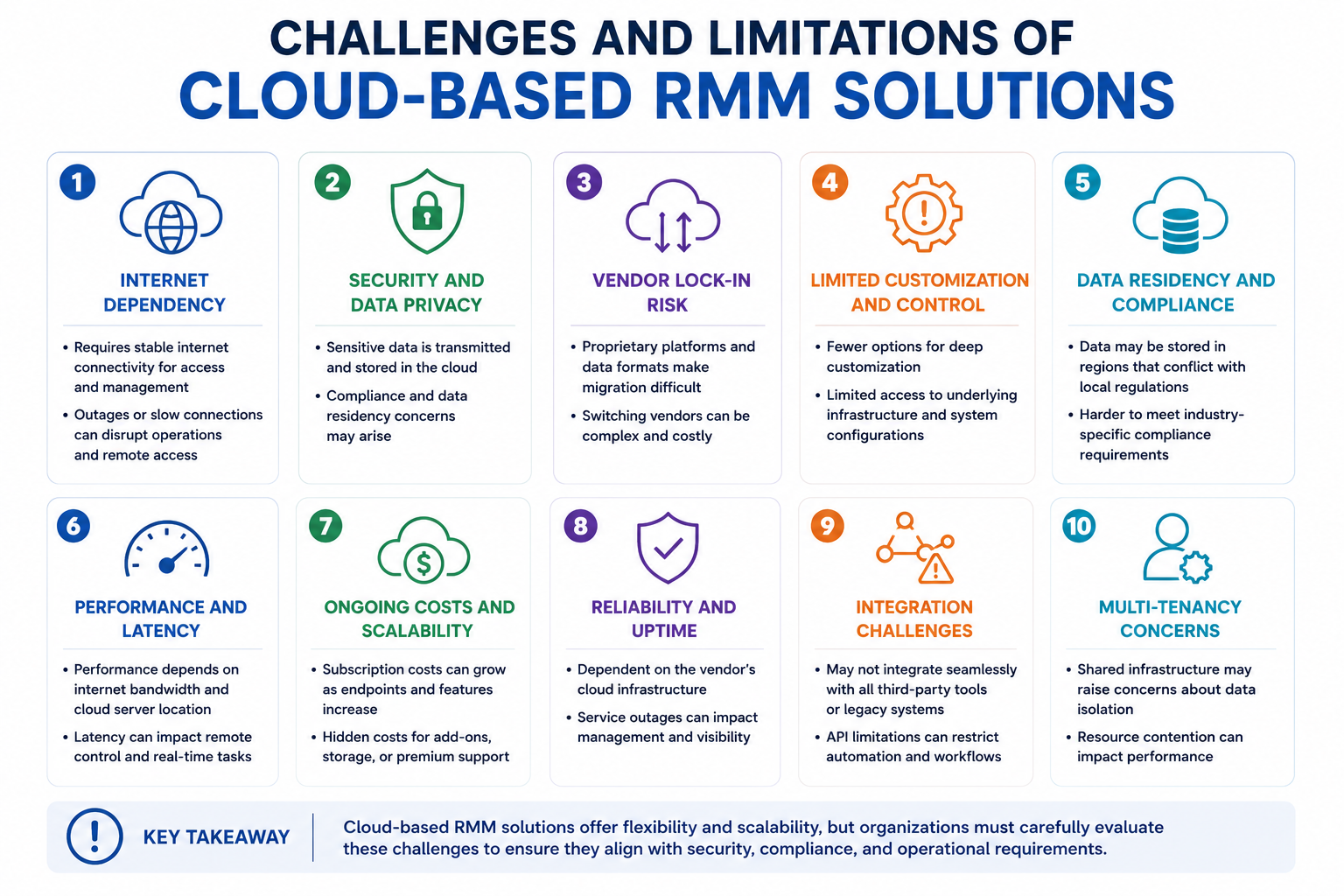
What are the challenges and limitations of Cloud-Based RMM Solutions?
Like every other system, cloud-based RMM solutions have notable advantages, but also have challenges. One central concern hinges on internet connectivity. Any interruptions make it impossible to access important systems and data. Another cloud-based RMM solutions challenge center around maintaining compliance with regulations. Some businesses operate in highly regulated sectors that have stringent requirements on data storage, block storage, and cloud-based handling, complicating any shifts to cloud-based solutions.
Learning these platforms poses challenges for some organizations.
Not every team is prepared to immediately adapt to new technology, which raises the risk of effectiveness and efficiency dips during the implementation phase. Similarly, security concerns cloud the narrative. Although cloud providers incur enormous expenses on security infrastructure, breaches and other system weaknesses can happen.
From a more practical point of view, unanticipated subscription expenses can catch some organizations off guard. While cloud-based RMM solutions appear wallet-friendly at first glance, poorly managed cloud-based RMM solutions can become stealthy subscription traps over time.
Nfina’s Cloud Based RMM
Nfina-View software is a cloud-based unified management dashboard which enables IT administrators and Managed Service Providers (MSPs) to view their organization’s key information at a glance. This IT Ecosystem management software increases the IT responsiveness and efficiency by covering the most crucial areas. Nfina-View software collects and integrates data from the servers, storage pools, and networking, to provide a single, summarized view of the IT ecosystem. This not only enables the user to monitor and manage their infrastructure but also offers a great deal of convenience. Nfina-View software integrates data from all servers, storage pools, and networking components in the IT ecosystem.
This data can then be displayed in summary and graphical form which enhances ease of management. Nfina-View Software is designed to be used by all industries and all sizes of organizations. Real-time and historical data is available to view. This blended IT software solution makes use of historical data and system monitoring. Nfina-View software is designed for hybrid IT and supports variable deployment possibilities which include but are not limited to, fully on-prem, private cloud, public cloud, colocation, multi-cloud and hybrid cloud.